



At Compassion Wyoming, we believe in transforming lives through compassion. By supporting prisoner rehabilitation and community reintegration, we offer hope for a brighter future. Together, we create pathways to opportunity, dignity, and long-term change.
More than four hundred lobbyists represent Wyoming’s ranchers, oil and gas industries, educators, and other well-funded groups. Yet for decades, inmates and their families had no organized voice to advocate for fair policies, accurate research, and informed public understanding.
Compassion Wyoming was founded to give inmates a voice and to counter the misinformation often shaped by Hollywood, media narratives, and political bias. Our purpose is simple: present facts, promote fair policies, and advocate for the rehabilitation and successful reintegration of long-term inmates.
A commutation is a governor-issued reduction in an inmate’s sentence. It is not a pardon.
Depending on the case, a commutation may shorten a sentence by a few years or by many.
Most commutations require three to five years of consistent progress before release is considered.
This petition asks the Governor of Wyoming to restore a proven strategy that helped rehabilitated long-term inmates for decades.
We request the reinstatement of past standards that enabled inmates—those who demonstrated a changed heart through consistent discipline, good behavior, participation in therapy, educational programs, and restorative activities—to be considered for commutations.
These inmates are typically disciplinary-free for years and show strong evidence of personal transformation.
Until 1995, Wyoming governors used commutations as a responsible exit strategy for rehabilitated long-term inmates.
However, after 1995, commutations nearly disappeared.
The data below shows a drastic drop over the last three administrations.

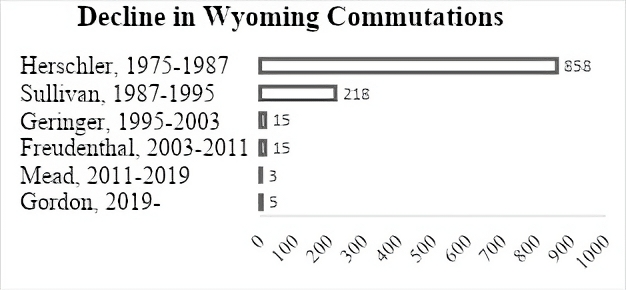
By signing this petition, you ask today’s governor to return to standards that successfully reduced prison overcrowding and rewarded genuine rehabilitation.
A commutation is a governor-issued reduction in an inmate’s sentence. It is not a pardon.
Depending on the case, a commutation may shorten a sentence by a few years or by many.
Most commutations require three to five years of consistent progress before release is considered.
This petition asks the Governor of Wyoming to restore a proven strategy that helped rehabilitated long-term inmates for decades.
We request the reinstatement of past standards that enabled inmates—those who demonstrated a changed heart through consistent discipline, good behavior, participation in therapy, educational programs, and restorative activities—to be considered for commutations.
These inmates are typically disciplinary-free for years and show strong evidence of personal transformation.
If yes, please support our mission by signing the petition below.
Your voice matters—and your signature could help restore a fair and compassionate process that has historically helped rehabilitated inmates return home safely.
Compassion Wyoming is rooted in Christian principles of mercy and redemption.
We work to facilitate safe and successful reentry for inmates who have demonstrated genuine change.
We believe that rehabilitation is possible, that data-driven policies reduce prison overcrowding,
and that public understanding grounded in facts—not fear—creates a stronger and safer Wyoming.
Our mission is to change public perspectives through honest communication, historical data, and compassionate advocacy, helping long-term inmates pursue a better future with dignity and purpose.

We use cookies to improve your experience on our site. By using our site, you consent to cookies.
Manage your cookie preferences below:
Essential cookies enable basic functions and are necessary for the proper function of the website.
These cookies are needed for adding comments on this website.
Google reCAPTCHA helps protect websites from spam and abuse by verifying user interactions through challenges.
Stripe is a payment processing platform that enables businesses to accept online payments securely and efficiently.
Service URL: stripe.com (opens in a new window)
Statistics cookies collect information anonymously. This information helps us understand how visitors use our website.
Google Analytics is a powerful tool that tracks and analyzes website traffic for informed marketing decisions.
Service URL: policies.google.com (opens in a new window)
Marketing cookies are used to follow visitors to websites. The intention is to show ads that are relevant and engaging to the individual user.
You can find more information in our Cookie Policy and Privacy Policy.
At Compassion Wyoming, we believe in mercy, redemption, and second chances. Your support helps us bring hope and successful reentry opportunities to those who have truly changed.
Would you consider making a small donation to support this mission of hope?